 CLICK HERE FOR PODCAST

05 Aug The St. Louis Real Estate Market Right Now, and What It Means for You
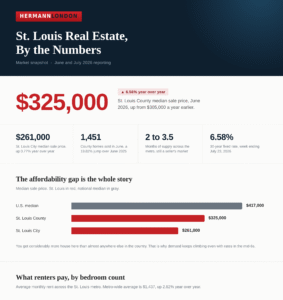
The St. Louis real estate market is sending mixed signals right now. Home prices in St. Louis County are up almost 7% over last year. Rents are up too. And mortgage rates just hit their highest point of 2026.
Those three facts pull in different directions depending on which side of the table you’re sitting on. So here’s the market broken down four ways, buyer, seller, investor, and renter, with the actual numbers behind each one.
The St. Louis real estate market, by the numbers
Here’s where the St. Louis metro stands as of the most recent reporting:
- St. Louis County median sold price: $325,000 in June 2026, up 6.56% from $305,000 a year earlier.
- St. Louis City median sold price: $261,000 in June 2026, up 0.77% year over year.
- County sales volume: 1,451 homes sold in June, a 19.82% jump over June 2025.
- Months of supply: roughly 2 to 3.5 months across the metro, depending on property type and location.
- 30-year fixed mortgage rate: 6.58% for the week ending July 23, 2026, per Freddie Mac.
- Average metro rent: $1,437/month, up 2.82% year over year.
One number deserves a callout. The national median sale price is sitting well north of $400,000. St. Louis County is at $325,000, and the City is at $261,000.
That gap is the whole story of this St. Louis real estate market. You get considerably more house here than almost anywhere else in the country, and that’s why demand keeps climbing even with rates in the mid-6s.
If you’re buying
The hardest part of buying in St. Louis right now isn’t finding a house you can afford. It’s moving fast enough on the good ones.
With supply hovering between two and three-and-a-half months, this is still a seller’s market by definition. Anything under six months of supply is. Well-priced, move-in-ready homes in the desirable suburbs go under contract in two to four weeks. Homes that need work, or that were priced on hope instead of comps, sit for 30 to 60 days or longer.
The practical takeaway: get fully underwritten before you tour anything. Not prequalified. Underwritten. When you’re competing for a well-priced house in Webster Groves or Kirkwood, a pre-underwriting letter is the difference between your offer getting a serious look and getting a polite pass.
About that rate
6.58% feels high if you’re anchored to 2021. It isn’t high by any longer historical measure, and waiting for it to drop has cost buyers real money over the last two years.
Run the math on your actual situation instead. On a $325,000 purchase, a half-point drop in rate saves you roughly $100 a month. In the same period you’d spend waiting for that half point, County prices climbed nearly 7%, about $21,000 on that same house.
Rates you can refinance. Purchase price you’re stuck with.
Where first-time buyers should actually look
The $150,000 to $300,000 range is where most first-time buyers land in St. Louis, and it’s deeper here than in most metros. South City, Affton, Overland, Ferguson, Maplewood’s edges, and parts of North County all have inventory in that band.
What matters more than the neighborhood name is the specific block and the specific condition of the house. A good agent walks you through both before you write an offer, not after the inspection comes back.
If you’re selling
You have the upper hand right now, and one common mistake can erase it.
County sales volume jumped nearly 20% year over year. Buyers are active. Prices are climbing. That’s the good news.
Here’s the catch: overpricing punishes you harder in this market than it used to. Buyers paying 6.58% are running tight monthly budgets and they’ve seen every comp on Zillow before they walk in your door. A house priced $20,000 over the comps doesn’t get a low offer. It gets no offer, then sits, then takes a price cut, then closes below where it would have if you’d priced it right on day one.
Price to the comps. Fix the obvious stuff. Let the market bid you up.
The two things worth spending money on before you list
Paint and floors. That’s it, in most cases.
Kitchen remodels rarely return what they cost in this price band. Fresh neutral paint and clean, uniform flooring change how every photo looks and how every showing feels, for a fraction of the money. Anything beyond that, get an opinion on the specific house before you write a check.
If you’re investing
The math still works in St. Louis. That’s rare in 2026.
Average metro rent is $1,437, with two-bedrooms at $1,636 and three-bedrooms at $1,799. Set that against a City median price of $261,000 and you have rent-to-price ratios that most coastal and Sun Belt markets stopped offering years ago.
Rents rose 2.82% year over year. Steady, not spectacular. That’s actually what you want. Steady rent growth in a market with a low entry price is how cash flow gets built and held.
Where the deals are hiding
Small multifamily. Two- and four-unit buildings in South City, Dutchtown, Bevo Mill, and the neighborhoods around them still trade at prices that pencil, and St. Louis’s older housing stock means there are a lot of them.
The trap is renovation scope. A 1920s four-family with original galvanized plumbing and knob-and-tube wiring can eat a year of projected cash flow in one week. Get a contractor walkthrough before you’re under contract, not during your inspection period when you’re already emotionally committed.
Commercial and larger deals
Commercial timelines in St. Louis run longer than residential. Expect months, not weeks, from first look to close. Financing terms and tenant quality drive the deal far more than the purchase price does.
If you’re evaluating a commercial property or a portfolio, the useful conversation happens before you’re in a contract. That’s when scope, financing structure, and exit strategy are still changeable.
If you’re renting, or you own rentals
These are two sides of the same market, and both are moving.
For renters: $1,437 is the metro average across all unit types, but that number hides a wide range. Studios average $1,045, three-bedrooms $1,799. Start your search 60 to 90 days before your lease ends. The good units in the good buildings go fast, and searching two weeks out means choosing from what’s left.
For owners: rising rents and rising home values mean your property is worth more and earning more than it was a year ago. It also means more to manage. More maintenance on aging stock, more tenant turnover, more compliance to track.
If you own one or two units and you’re handling it yourself, the question isn’t whether you can. It’s whether your time is better spent on the next acquisition than on a 9pm call about a water heater.
Questions we get every week
Is now a good time to buy in St. Louis?
If you’re staying five years or more and your budget works at today’s rates, yes. Prices are climbing steadily and St. Louis remains one of the most affordable major metros in the country. If you’re planning to move within two years, renting probably costs you less after transaction costs.
How long does it take to sell a house in St. Louis?
A well-priced, move-in-ready home typically goes under contract in two to four weeks. Add 30 to 45 days for closing. Homes needing work or priced above the comps commonly take 30 to 60 days or more just to find a buyer.
What’s the difference between St. Louis City and St. Louis County?
They’re separate jurisdictions with different tax structures, school districts, and inspection requirements. The City median sits at $261,000 and the County at $325,000, but that gap reflects housing stock and location as much as anything. Some City neighborhoods outperform some County suburbs.
Do I need 20% down?
No. Conventional loans go to 3% down, FHA to 3.5%, and VA to zero for eligible buyers. Missouri also has down payment assistance programs worth checking. You’ll pay mortgage insurance under 20%, so run both scenarios before deciding.
What does property management cost?
It varies by the number of units, property type, and services included. The right comparison isn’t the fee against zero. It’s the fee against vacancy weeks, bad tenant placements, and your own hours.
The one thing worth doing this week
Whatever side of this St. Louis real estate market you’re on, the mistake is waiting for perfect information. Rates move, inventory turns over, and the specific house or tenant or building that fits your situation is available for a window, not forever.
Tell us what you’re trying to do and we’ll tell you straight whether the timing works, whether you’re buying, selling, investing, or handing off a rental you’re tired of managing.
Start a conversation with the Hermann London team. No pitch, no pressure. Just a real read on your situation from people who work this market every day.
Hermann London
Market data reflects June and July 2026 reporting from St. Louis REALTORS®, Freddie Mac’s Primary Mortgage Market Survey, and RentCafe. Figures change monthly. Reach out for current numbers on your specific neighborhood or property type.
For the latest data shaping the St. Louis real estate market, see the Freddie Mac Primary Mortgage Market Survey.